
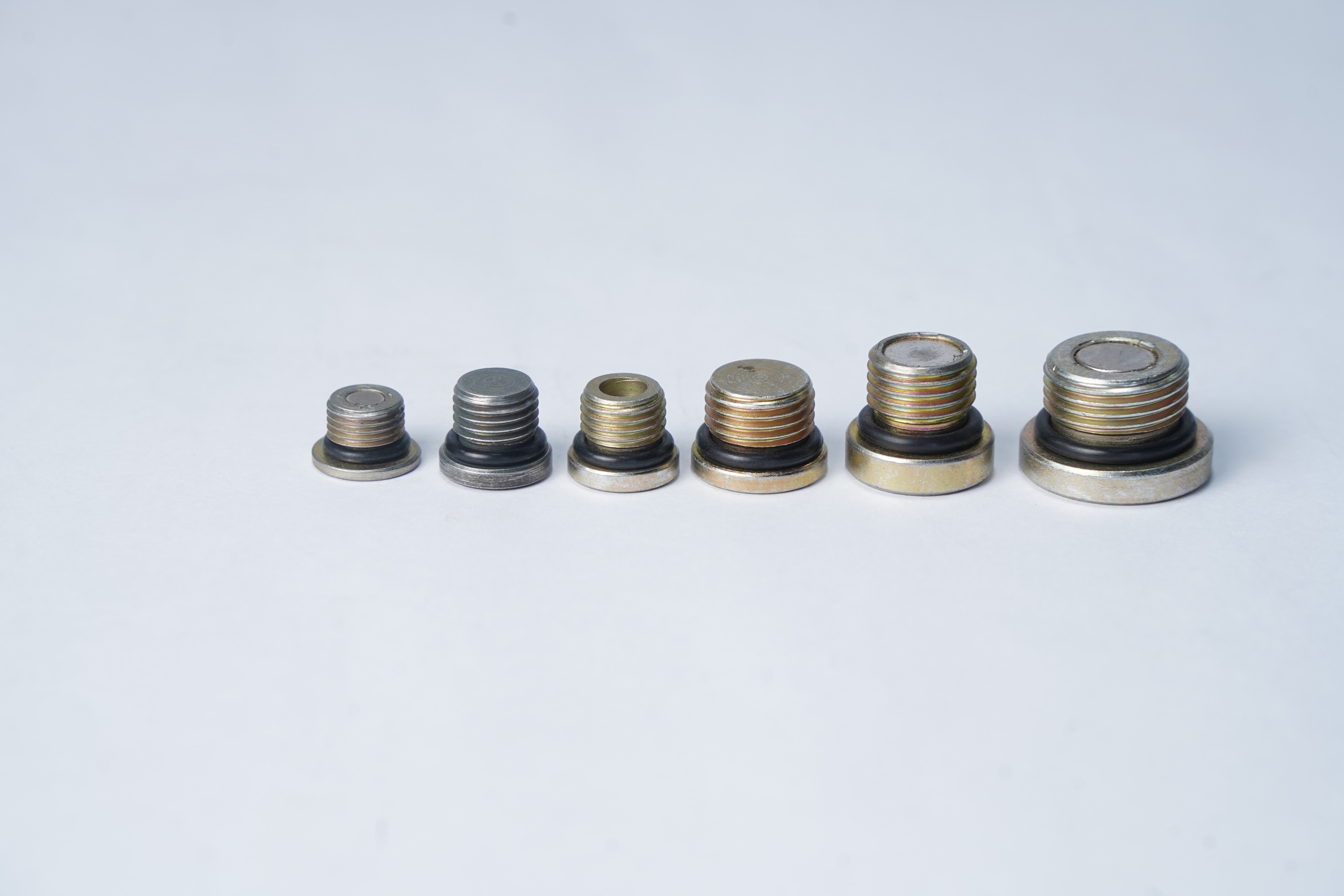
“One half UNF” does not identify a complete purchase specification: you still need the pitch, thread form, seal arrangement, magnet construction and service limits. By the end, you will know which parts should be in the package, how to verify the fit, and what to request before ordering for an oil or fluid circuit.
Key takeaways
- Confirm whether 1/2 UNF means the complete 1/2-20 UNF thread specification.
- Request the plug, magnet, seal and installation information as separate package items.
- Specify magnet material, pull force, temperature limit and oil compatibility.
- Put thread class, torque, sealing method and service limits on the drawing.
What does “one half UNF” identify?
“1/2 UNF” is incomplete for purchasing: the usual specification is 1/2-20 UNF, meaning a 0.500-inch nominal major diameter, 20 threads per inch and a straight, 60-degree Unified thread form.
Confirm whether the plug has an external thread or accepts an internal thread, plus the thread class (such as 2A or 2B), engagement length, usable port depth and dimensional tolerances.
1. Request a drawing that identifies the mating port, boss or adapter, shoulder and sealing face. A straight 1/2-20 UNF thread is not the same as 1/2 NPT, which is tapered, or 1/2 BSPP/G1/2, which uses different pitch and flank geometry.
These parts are not interchangeable; forcing one into another can damage the port or create a leak.
2. Confirm the drive: external hex, socket or internal drive, together with its across-flats, socket or key size. “One half” does not identify the drive or the plug’s usable length.
3. Before installation, inspect the port and use a calibrated 1/2-20 UNF thread plug gauge for an internal port or a thread ring gauge for an external plug. Measure the port depth and sealing-face position; do not rely on visual comparison.
A one half UNF magnetic pipe plug supplier should provide these details before quoting. A Düsseldorf buyer searching what comes with a one half UNF magnetic pipe plug should treat the thread designation as a starting point, not proof of fit.
Which parts should be in the package?
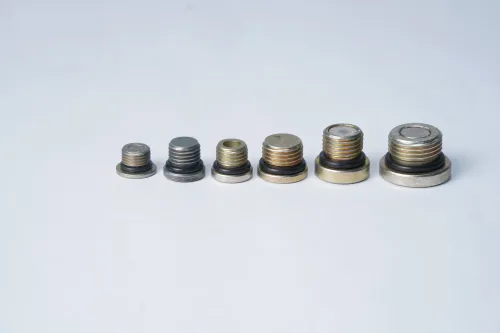
A package must state exactly what arrives: the machined plug, integral magnet, sealing element, quantity, material and replacement status. “Magnetic” alone does not include a washer, O-ring, gasket, installation tool or protective cap.
| Supply format | Items received | Replacement status |
|---|---|---|
| Integral-magnet plug | Plug with retained magnet; no separate seal unless stated | Magnet is not a replacement seal |
| Plug with washer | Plug plus one copper, aluminum or fiber washer | Washer is normally single-use; order replacements |
| Plug with bonded seal | Plug plus one specified bonded seal | Replace after removal or visible crushing |
| Plug with O-ring | Plug with O-ring installed in a defined groove | Replace if cut, flattened, swollen or lost |
On a straight 1/2-20 UNF thread, the threads position and retain the plug. Sealing comes from the machined face, shoulder, washer, bonded seal or O-ring. PTFE tape is not a substitute for that specified seal; it can alter seating, shed fragments or prevent the plug reaching its designed position.
Ask the one half UNF magnetic pipe plug supplier to identify every included item, material, quantity and replacement part number. A missing washer causes a face leak, a lost O-ring leaves the groove empty, and a reused crushed seal can leak even when the plug reaches the expected torque.
Do not assume an installation tool or cap is supplied unless the quotation lists it.
What magnet and body specifications matter in service?
Suitability depends on the magnet, the plug body and the fluid circuit, not on the word “magnetic.” Require the supplier to state the magnet type or grade, exposed or encapsulated construction, pull force or minimum retention force, operating-temperature limit, corrosion protection and insert-retention method.
A pull-force figure measured against a thick flat-steel plate does not predict collection of irregular chips through an oil film.
- Specify plug-body material, hardness, surface finish, corrosion resistance and compatibility with petrol, engine oil, hydraulic fluid and coolant.
- Check internal clearance at the sump or gallery, vibration exposure, galvanic compatibility with the housing and the consequence of a loose insert entering the oil circuit.
- Treat the magnet as a ferrous-debris indicator and coarse collector, not a filter: it will not capture aluminum, copper, brass, austenitic stainless-steel particles or nonmetallic contamination.
Magnet position changes both collection and durability:
| Option | Service advantage | Limitation |
|---|---|---|
| End-mounted | Reaches the sump low point and collects settled debris | More exposed to impact and cleaning damage |
| Recessed | Protects the magnet from direct knocks | May offer less direct contact with circulating chips |
| Fully encapsulated | Best protection against impact, washing and insert loss | Encapsulation can reduce magnetic access to debris |
For magnetic pipe plug specifications Germany is not a separate standard; state 1/2-20 UNF, materials, limits and inspection details explicitly. Ensure the drawing shows the magnet position and retention method.
Which service limits and installation controls belong on the drawing?
A plug that fits is not safe to install until the drawing states working pressure, burst or proof pressure where applicable, working-temperature range, leak-test method, sealing configuration and permitted tightening torque.
No universal torque exists for 1/2-20 UNF: the value changes with housing material, thread engagement, lubrication, washer or O-ring design and allowable port stress, especially in aluminum. The drawing must show datums, major and minor diameter, pitch diameter, tolerances, sealing-face or groove geometry, drive size, magnet position and minimum thread depth.
| Control | Why it changes the installation limit |
|---|---|
| Housing material | Aluminum tolerates less port stress than steel |
| Thread engagement | Short engagement reduces load capacity |
| Lubrication | Lower friction raises clamp load at the same torque |
| Washer or O-ring | Seal compression determines the tightening method |
| Port design | Shoulder geometry and allowable stress control torque |
Use this inspection checklist before release:
- Gauge the internal or external thread and verify the drawing dimensions.
- Remove burrs from the port, sealing face and drive.
- Confirm magnet presence, position and retention.
- Confirm the specified washer, bonded seal or O-ring is included.
- Perform the specified sample leak test.
For magnetic pipe plug specifications Germany, state the inch thread explicitly as 1/2-20 UNF; German location does not create a different thread standard. A magnetic pipe plug for oil systems also requires a separate Pressure Equipment Directive assessment based on the complete equipment, fluid group, pressure and volume or nominal size, not the plug alone.
What should you request from a supplier before ordering?
A one half UNF magnetic pipe plug supplier should quote evidence, not just a product title or location. Request a controlled drawing and a sample inspection report; “magnetic pipe plug manufacturer Düsseldorf” does not define the thread, seal or service limits.
- 1/2-20 UNF thread, thread class, external or internal form, engagement length and usable depth
- Plug material, coating, dimensional tolerances and drive size
- Magnet grade, placement, temperature rating and retention method
- Seal type and included quantity: washer, bonded seal, O-ring or plug alone
- Working pressure, temperature limits, tightening torque and leak-test method
- Lot traceability, packaging specification and replacement-seal identification
Compare the quotation against the evidence you will receive:
| Evidence | Accept | Reject |
|---|---|---|
| Controlled drawing | Datums, tolerances, seal geometry and magnet position | “1/2 UNF” with no dimensions |
| Inspection report | Gauged-thread results, material and seal checks | Visual inspection only |
| Service data | Defined pressure, temperature, torque and leak method | “Suitable for industrial use” |
| Traceability | Lot or batch linked to inspection records | Unmarked bulk packaging |
A precision-machining source such as Efficient Precision & System Pvt.Ltd is useful when it supplies that controlled drawing, gauged-thread results, documented seal configuration and traceable inspection for repeat orders. Ask for a first-article sample before production, then verify the mating port, seal fit and internal clearance.
Approve the batch only after those checks pass, rather than choosing the plug because it is associated with Düsseldorf or labelled magnetic.
Related product
 | Sliding head parts A Magnetic Pipe Plug is a specially constructed plug that seals pipe holes while also attracting and trapping ferrous (iron-based) particles in... View product → |
Frequently asked questions
What does one half UNF identify?
It identifies a 0.500-inch nominal major diameter and, when fully specified as 1/2-20 UNF, 20 threads per inch with a straight 60-degree Unified thread form.
Which parts should come with a one half UNF magnetic pipe plug?
Confirm whether the package includes the threaded plug body, permanently fitted magnet, sealing washer or O-ring, protective cap, and installation instructions. Do not assume a seal is included.
Which magnetic pipe plug specifications matter in service?
Check the magnet material, magnetic pull force, operating temperature, corrosion resistance, oil compatibility, body material, thread class, overall length and debris-capture geometry.
What should you request from a magnetic pipe plug supplier before ordering?
Request a dimensioned drawing, complete 1/2-20 UNF thread callout, material and finish details, magnet data, seal specification, torque guidance, service limits, inspection records and certificate of conformity.