
A magnetic pipe plug quotation can cover only a machined plug with an installed magnet, while the washer, O-ring, retainer and inspection documents remain optional. By checking the supplied parts, drawing dimensions, sealing method, service limits and acceptance records, you can place an order that fits the port and survives its actual operating conditions.
Key takeaways
- Confirm whether seals, washers, tools and spare magnets are included.
- Specify thread standard, size, engagement length, seal type and service limits.
- Request material certificates, dimensional inspection results and magnet verification records.
- Clean the plug and inspect its seal before every replacement.
What should be inside one magnetic pipe plug order?
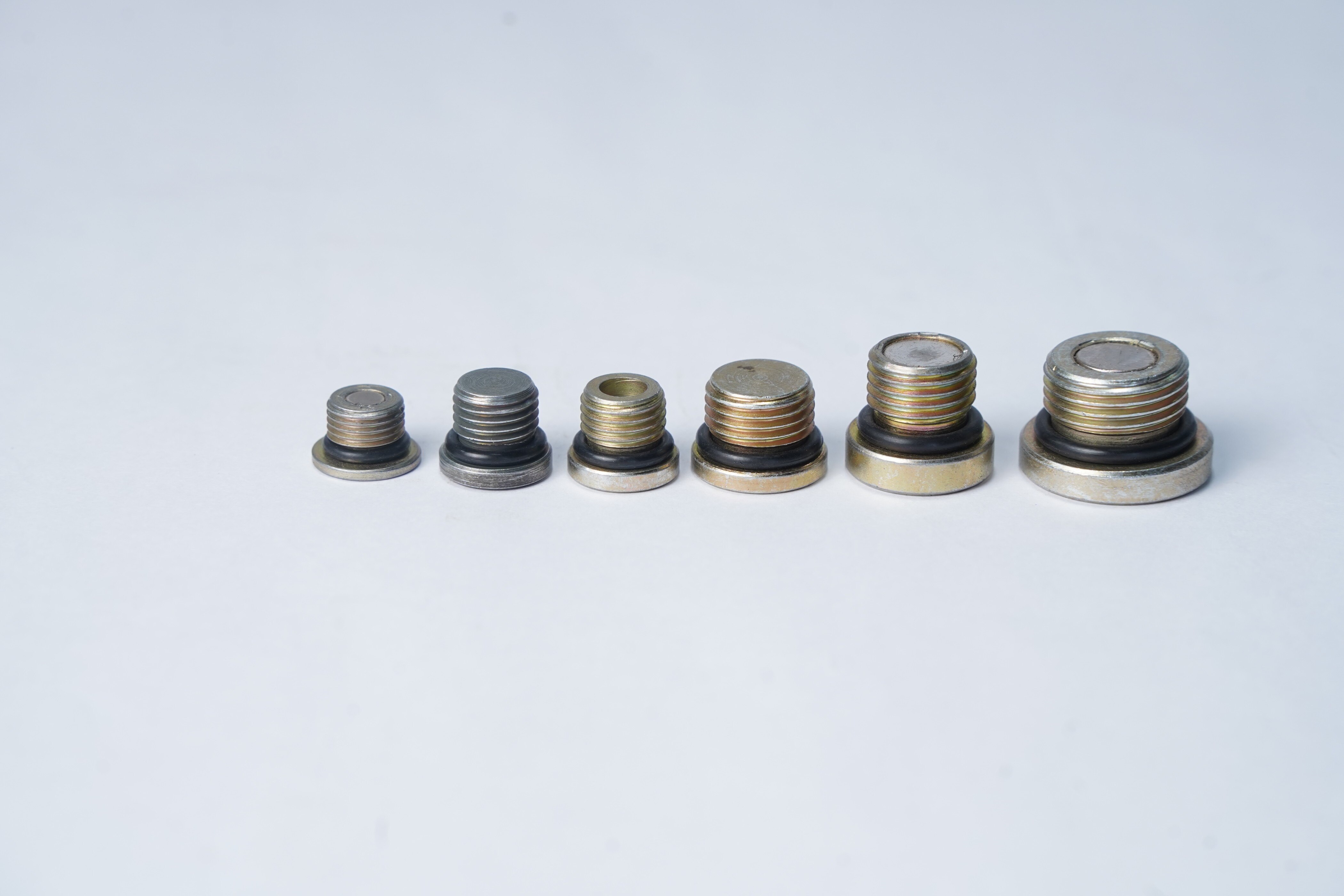
A normal magnetic pipe plug order includes the machined plug body and an integrated or retained permanent magnet. Confirm what is included with magnetic pipe plug before approving the quotation; a washer, O-ring, thread sealant, installation tool, replacement magnet or spare seal is not automatically part of the supply.
1. Standard supply: specify the plug body, retained magnet, thread, material, finish and quantity against the controlled drawing. List the industrial magnetic pipe plug parts by part number if the magnet, retainer or protective cap is supplied as a separate component.
2. Request explicitly: add a sealing washer or O-ring, spare seals, replacement retainers, replacement magnets, thread sealant, installation tooling, protective caps and fitting instructions as separate line items. State whether the magnet is installed, individually packed or supplied loose.
3. Request documents and packaging: include the inspection report, material certificate such as EN 10204 type 3.1, magnet test result, conformity statement, packaging quantity and identification label when required. These records are not inherent specifications of the plug.
4. Complete the magnetic pipe plug order details: give quantity, lot size, delivery date, delivery location, country of origin, HS code, Incoterm and VAT treatment. If buying from a magnetic pipe plug supplier in Germany, state whether you require a German legal entity, dispatch from Germany or German manufacture; those conditions are different.
Which specifications prove that the plug will fit?
Fit is proved by the controlled drawing, not by a label such as “M12 plug” or “1/4-inch plug.” M12 must state the thread form and pitch, such as M12 × 1.5, while a 1/4-inch designation must identify NPT, BSPP, BSPT or another standard, plus TPI and gauge requirement.
Put these magnetic pipe plug specifications on the drawing or purchase order:
- Thread major diameter, pitch or TPI, tolerance class, thread engagement length, and required internal or external gauge
- Overall length, insertion length, bore depth, clearance, head diameter, hex or drive size, chamfer and lead-in
- Sealing-face diameter, width, flatness and surface finish; identify a washer seat, O-ring groove or metal-to-metal seal
- Magnet diameter, length, grade, polarity when relevant, recess dimensions and retention method
- Material, coating or finish, burr limits, cleanliness requirement and any protective cap
| Callout left unresolved | What it fails to prove | Typical consequence |
|---|---|---|
| Thread | Pitch, form and gauge acceptance | The plug starts but binds, leaks or damages the port |
| Head and length | Tool clearance, seating depth and external interference | The plug bottoms out before sealing or cannot be installed |
| Magnet and recess | Retention, position and available clearance | The magnet loosens, projects into the bore or misses particles |
| Sealing face | Seal type and contact geometry | A washer or O-ring cannot compress correctly |
A certificate of conformity does not prove every dimension or magnet retention. Require inspection evidence for thread gauging, sealing-face geometry, magnet presence and retained construction; these details define the industrial magnetic pipe plug parts you can accept.
How do thread type, seal and service limits change the order?
Choose tapered or parallel threads based on how the port seals, not on diameter alone. A tapered thread tightens by wedging into the port; a parallel thread needs a defined sealing face, washer or O-ring. The wrong choice can leave a plug that fits the first turns but leaks at working pressure.
| Thread type | Sealing method | Order implication |
|---|---|---|
| Tapered pipe thread | Thread sealant or compatible sealing compound | State thread standard, engagement length and sealant compatibility |
| Parallel thread | Washer, bonded seal or O-ring at a face | Specify seal material, groove or face dimensions and replacement quantity |
| Parallel thread with O-ring | Radial or face seal | State O-ring size, compound, temperature range and fluid compatibility |
Do not assume thread sealant is included or suitable. List the washer, O-ring, retainer, sealant and installation tool as separate line items, or state that they are excluded. Seal choice changes with hydraulic oil, gearbox oil, water, fuel and aggressive chemicals.
Put these magnetic pipe plug order details in the RFQ:
- Working, proof-test or burst pressure; never substitute magnetic pull force for a pressure rating.
- Minimum and maximum fluid temperature, including the magnet’s maximum service temperature and grade.
- Service fluid, contaminant target and cleaning requirement; the magnet will not collect aluminium, copper, brass or many stainless-steel particles.
- Plug-body material, corrosion requirement and surface finish.
- Thread gauge requirement, magnet-retention method and any EN 10204 type 3.1 certificate.
This service envelope prevents a dimensionally correct plug from failing through heat, corrosion or inadequate sealing.
How should you install, clean and replace the plug?
Install the plug against the controlled drawing and the supplier’s torque value, not by feel. Confirm what is included with magnetic pipe plug orders: a sealing washer, O-ring, thread sealant, installation tool, protective cap, or replacement magnet is not automatic. Industrial magnetic pipe plug parts supplied separately must appear as line items.
1. Clean the port and plug threads, remove chips, and protect the magnet from impact. Check that the magnet is retained and that its collecting face points into the fluid passage; follow the drawing if polarity or orientation is specified.
2. Inspect the washer or O-ring for cuts, flattening, hardening, contamination, and correct material. Replace a damaged seal before fitting. Do not use thread sealant on a sealing face, and apply only a fluid-compatible sealant where the thread design permits it.
3. Start the plug by hand to prevent cross-threading. Tighten to the specified torque with a calibrated wrench; excessive torque can strip the port, crush an O-ring, or distort the sealing face. Keep the thread and magnet free of sealant squeeze-out.
4. At service intervals, remove the plug with the system depressurised, wipe particles into a clean container, and inspect them. The magnet collects ferrous debris, not aluminium, copper, brass, or every stainless-steel particle.
5. Replace the plug when threads, sealing faces, magnet retention, or corrosion resistance are damaged. Replace the seal after removal when the manufacturer prohibits reuse, and record the replacement date and particle findings.
What should an industrial RFQ and inspection package contain?
An RFQ that says “M12 magnetic plug” leaves too much open for acceptance. Put the controlled drawing revision, magnetic pipe plug specifications and magnetic pipe plug order details in one package, then require the quotation to identify every exclusion.
1. Attach the drawing revision, thread standard, pitch, gauge requirement, material, finish, sealing arrangement and service envelope: fluid, pressure, temperature and corrosion exposure.
2. Define the magnet by material or grade, diameter, length, coating, temperature limit and retention method. State the magnetic-force test plate, air gap, contact area and loading direction; figures from different test conditions are not comparable.
3. Request inspection evidence for thread gauges, sealing-face geometry, critical dimensions, burr control, surface finish, cleanliness, magnet presence and polarity where relevant, plus a retention test. A certificate of conformity alone does not prove these checks.
4. List what arrives in the pack: plug, installed magnet, washer or O-ring, retainer, protective cap, instructions and replacement parts. Specify packaging quantity, particle protection and labels rather than assuming accessories are included.
5. Add quantity, lot size, first-article requirement, delivery date, delivery location, country of origin, HS code, Incoterm, VAT treatment and any EN 10204 type 3.1 certificate.
6. Ask a magnetic pipe plug supplier germany whether it is a German legal entity, ships from Germany or only has German representation. Ask Efficient Precision & System Pvt.Ltd to identify its drawing revision, inspection records and excluded items in the quote.
Related product
 | Sliding head parts A Magnetic Pipe Plug is a specially constructed plug that seals pipe holes while also attracting and trapping ferrous (iron-based) particles in... View product → |
Frequently asked questions
What is included with a magnetic pipe plug order?
The order normally includes the machined plug body and an integrated or retained permanent magnet. Confirm whether washers, O-rings, thread sealant, installation tools, replacement magnets and spare seals are included.
Which magnetic pipe plug specifications prove that the plug will fit?
Check the port size, thread standard, thread designation, pitch, engagement length, overall length, sealing face and wrench feature against the mating component drawing.
How do thread type, seal and service limits change the order?
Specify the exact thread form, seal arrangement, compatible material, pressure rating, temperature range and fluid exposure. These details determine the body, seal and inspection requirements.
What should an industrial RFQ and inspection package contain?
Include the part drawing, quantities, material and magnet requirements, thread and seal details, service conditions, marking instructions, packaging requirements and requested dimensional, material and magnet inspection records.