
A plug that matches the nominal port size can still leak, damage an aluminium housing, or lose its debris-capture value if the thread, seal, magnet and clearance are wrong. By comparing the plug form, thread standard, pressure boundary, magnet construction and maintenance access, you can specify a design that fits the actual piping circuit.
Key takeaways
- Match plug geometry to port clearance, flow direction and inspection access.
- Specify thread, seal material and pressure boundary as one assembly.
- Place the magnet where it captures contaminants without obstructing flow.
- Define cleaning, torque and inspection steps before approving the plug.
Match the plug form to access, flow and maintenance
Your first decision is how to choose a magnetic pipe plug around the port’s layout and inspection routine, not the magnet’s advertised pull force. Match the wetted-end position to radial and axial clearance, flow direction and impact risk.
| Decision | Specify | Why it matters |
|---|---|---|
| Thread and nominal size | Port thread, male or female form, nominal diameter | Prevents an incompatible plug or restricted opening |
| Sealing method | Tapered thread, O-ring, bonded washer or gasket | Defines pressure containment and replacement work |
| Magnet material and retention | Ferrite, neodymium or samarium-cobalt; pocket, cup, sleeve or staking | Balances temperature, corrosion and impact resistance |
| Maintenance and access | Fixed insert, removable cartridge or externally retained magnet | Determines whether you can inspect debris without replacing the body |
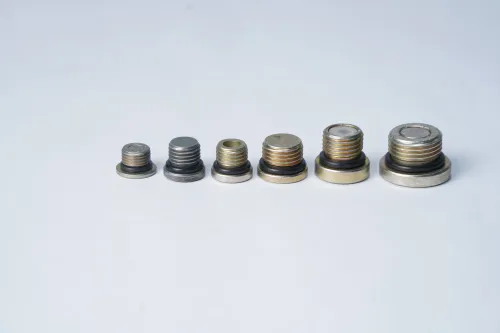
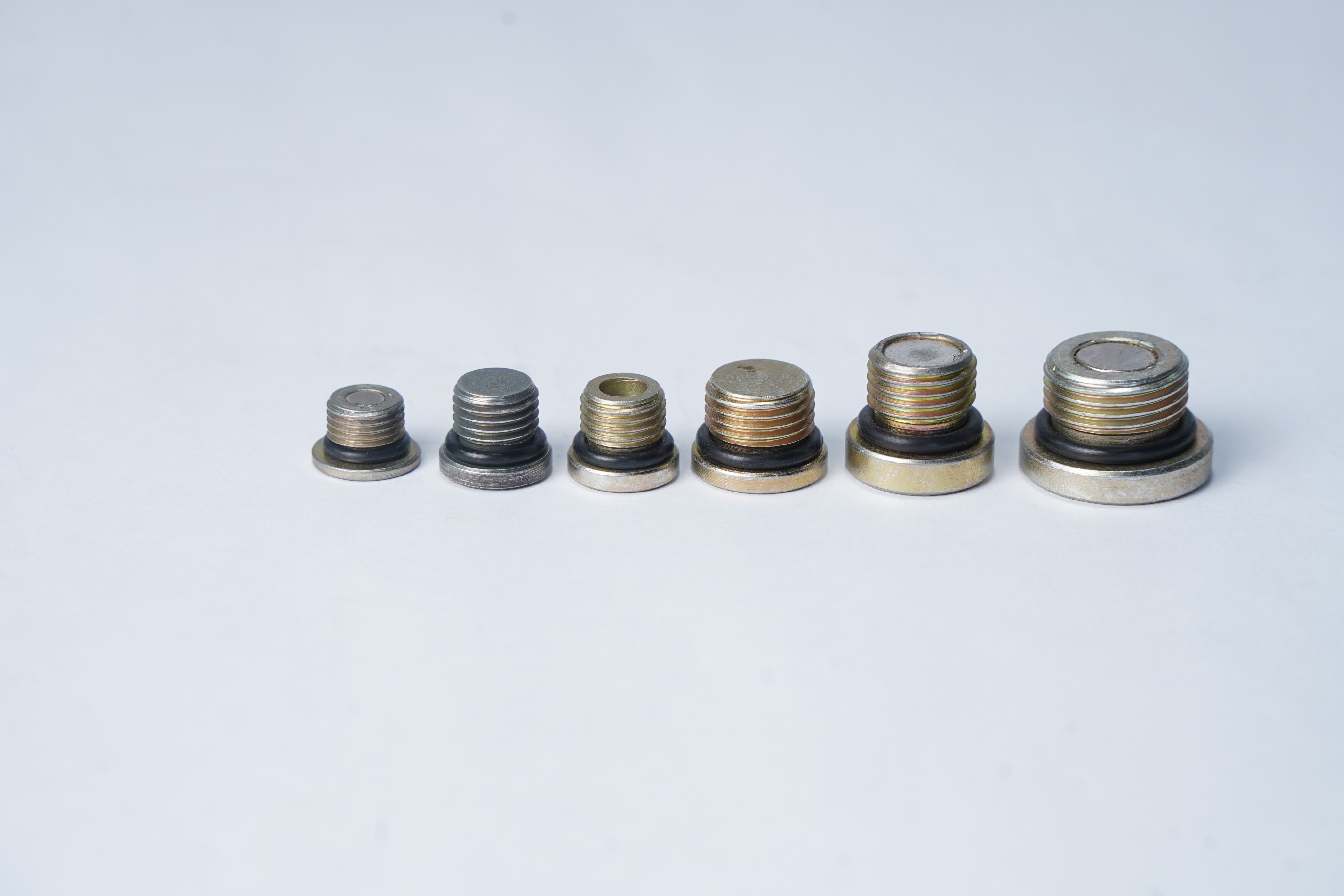
Threaded drain plugs suit low points where routine removal lets you wipe collected swarf away. A recessed magnet or cup- or sleeve-retained magnet protects a brittle element and reduces debris loss under flow. Screw-in inspection plugs suit ports where you need direct visual access to the collection face.
Use a flush plug when nearby parts, guards or moving components leave no room for protrusion; its flush magnetic insert faces greater impact exposure. Choose an externally retained plug when the magnet or replaceable magnetic cartridge must come out without disturbing the pressure-sealing body.
Place the magnet at the wetted end, but avoid a sharp pocket that permanently traps sludge.
Specify the thread, seal and pressure boundary as one assembly
Prevent leakage and port damage by specifying the thread, seal and pressure boundary as one assembly—not by ordering a generic magnetic pipe plug. State the actual standard and size: metric, NPT, BSPT or BSPP/G, plus male or female form, nominal diameter, thread engagement and surrounding clearance.
A 1/4 NPT thread has 18 threads per inch; G 1/4 has 19. Different pitch and flank geometry make them non-interchangeable.
| Decision | Specify | Consequence |
|---|---|---|
| Thread | Standard, size, male or female form | Prevents cross-threading and insufficient engagement |
| Seal | Tapered thread with compatible sealant, or parallel thread with O-ring, bonded washer, copper washer or gasket | A parallel thread is not pressure-tight because a magnet is present |
| Boundary | Plug wall, body material, temperature, torque and female-thread condition | Sets the assembly pressure limit |
| Access | Head shape, radial clearance and axial clearance | Prevents tool interference and impact damage |
DIN 906, DIN 908 and DIN 910 are German-market plug forms with different heads and sealing arrangements; identify the exact form on the drawing. For magnetic pipe plug options, compare the complete installation, not the magnet’s pull-force figure.
Pressure rating belongs to the plug wall, material strength at temperature, sealing element, specified torque and port condition. A pull-force value measured on a clean steel plate says nothing about pressure containment.
Choose magnet material and placement for the contaminant you actually have
Match the magnet to the debris, not merely the fluid. In oil, petrol, coolant and hydraulic circuits, permanent magnets capture ferromagnetic iron and many steels; they do not reliably remove aluminium, copper, brass, titanium, polymers, fibres, water or chemical contaminants.
Annealed 304 and 316 stainless are normally weakly magnetic, while duplex and ferritic stainless are substantially more magnetic. Magnetic pipe plug types therefore provide selective capture, not filtration.
Compare ferrite, neodymium and samarium-cobalt against temperature, corrosion and available volume before choosing magnetic pipe plug for options.
| Material | Strength and volume | Main limitation |
|---|---|---|
| Ferrite | Lower strength; economical and corrosion-resistant | Needs more space |
| Neodymium | Highest energy in a small volume | Corrosion risk; standard grades commonly operate around 80 °C, with higher-temperature grades available |
| Samarium-cobalt | High temperature and corrosion resistance | Brittle and more expensive |
Use a recessed or cup- or sleeve-retained magnet to shield a brittle element and prevent flow from tearing collected swarf away. A flush insert improves access but receives more impact. Specify mechanical capture, a protective sleeve, staking or compatible encapsulant; press fit alone can loosen under vibration, thermal cycling or hydraulic shock.
Do not treat flat-plate pull force as in-pipe capacity. A plug wall, coating, oxide, sludge or scale creates an air gap that reduces force. Size the magnet and collection face for the actual ferrous load, while recognising that nonmagnetic contamination still needs conventional filtration.
Install, clean and inspect the plug without compromising the housing
Preserve the housing by treating installation as a sealing procedure, not a magnet-fitting task. Before you choose a magnetic pipe plug, match its installation method to the port material and sealing interface.
1. Clean the port completely. Remove chips, dirt and old sealant, then confirm the actual thread standard and size. Cross-threading a plug damages the female thread before torque even becomes relevant.
2. Start the plug by hand and verify full engagement and correct seating. Use the specified sealant on tapered threads because the thread flanks form part of the pressure boundary. Use the defined O-ring, washer or gasket on parallel threads; a BSPP or metric thread does not seal simply because it has a magnet.
3. Apply the specified torque with a calibrated torque wrench. Do not tighten until the plug “feels secure”: over-tightening can distort the sealing face or strip aluminium female threads, creating a housing repair that costs more than the plug.
4. Check the sealing face, O-ring and washer for cuts, flattening, corrosion or embedded chips. Replace damaged sealing elements rather than reusing them, then raise pressure and temperature gradually to the operating range and inspect for leakage.
5. Remove and clean the magnet or accessible collection face at each inspection. A sudden increase in ferrous debris can indicate wear from gears, bearings, pumps or valves, but examine the debris first; magnetic collection does not show particle-size distribution or diagnose the failure by itself.
Turn the choice into a complete procurement specification
Put the complete assembly on the drawing or purchase order, not merely “magnetic pipe plug.” A search for “magnetic pipe plug manufacturer germany” or “magnetic pipe plug for options” is only a starting point.
1. State the thread standard and nominal size: metric, NPT, BSPT or BSPP/G; male or female form; plug type; body material; sealing method and material. For German procurement, ask whether DIN 906, DIN 908 or DIN 910 applies, and whether an EN 10204 inspection certificate is required.
2. Define the magnet and its pocket: magnet material and grade, diameter, depth, concentricity, edge break and complete burr removal. Specify the retention method, such as a sleeve, staking, mechanical shoulder or compatible encapsulant. Excessive interference can crack a sintered magnet; insufficient interference can let it migrate.
3. Add operating temperature, pressure, fluid, corrosion exposure, installation torque, inspection access and replacement interval. Rate pressure for the complete installation, including wall thickness, thread engagement, seal, temperature, torque and female-thread condition—not the magnet’s pull-force figure.
Require a drawing review, thread and sealing confirmation, material and magnet-grade certificates, dimensional inspection records, retention details and sample validation. Efficient Precision & System Pvt.Ltd should be assessed against those records rather than a generic quotation.
Related product
 | Sliding head parts A Magnetic Pipe Plug is a specially constructed plug that seals pipe holes while also attracting and trapping ferrous (iron-based) particles in... View product → |
Frequently asked questions
How do you choose a magnetic pipe plug design?
Match the plug form to radial and axial clearance, flow direction, impact exposure and the way you will remove and inspect it.
What must a magnetic pipe plug specification include?
State the port thread, engagement length, seal type and material, pressure and temperature limits, wetted materials, magnet material, magnet position and retention method.
Where should the magnet sit in a pipe plug?
Place it in the contaminant path while keeping it clear of moving parts, narrow passages and impact zones. Choose axial or radial placement based on flow and access.
How do you maintain a magnetic pipe plug without damaging the housing?
Use the specified tool and torque, remove the plug without cross-threading, clean the magnet with a suitable method, inspect the seal and threads, and replace damaged parts before refitting.