
A valve shaft cannot be selected by material name alone: temperature, pressure, medium chemistry, torque, thrust, sealing method and wear pair all change the correct specification. By the end, you will be able to compare industrial valve shaft options, match materials and surface treatments to service conditions, and choose a shaft geometry that manufacturers can produce and inspect reliably.
Key takeaways
- Define load, sealing zone and service medium before choosing shaft material.
- Use martensitic stainless steel for hardness; choose duplex or nickel alloys for severe corrosion.
- Specify heat treatment, coating, runout, straightness and surface-finish requirements separately.
- Match one-piece, split, keyed or splined shafts to the valve and actuator interface.
Start with the load case, sealing zone and service medium
Fix the load path, sealing zone and service medium before comparing valve shaft materials. A material ranking is incomplete without the actuator interface, because the section through packing or a bellows seal needs tighter straightness, lower runout and a controlled surface than the section inside the coupling.
Freeze these service inputs:
- Medium chemistry, chloride level, temperature, pressure, erosion risk and sour-gas exposure
- Cycle count, actuator torque or thrust, required leakage class, and packing or bellows-seal type
- Shaft diameter, thread or spline, coupling dimensions, corrosion allowance and inspection limits
| Load path | Design consequence | Material question |
|---|---|---|
| Rising stem | Carries actuator thrust; check column buckling, thread wear and straightness | Is yield strength sufficient at operating temperature? |
| Quarter-turn stem | Carries torsion and bending from the ball, disc or plug | Is fatigue, galling and surface hardness controlled? |
| Sealing zone | Passes through packing or a bellows seal; leakage follows runout, scoring or poor finish | Does the grade and process deliver the specified finish? |
Specify 17-4 PH heat condition, such as H900 or H1150, rather than listing only the grade. Rough-machine, heat-treat and finish the sealing diameter and actuator interface after measuring batch distortion. Use ASME B16.34 for pressure-temperature and material framework, then control shaft geometry separately.
Compare stainless, carbon, alloy steel and copper-based shafts
Price alone produces bad shaft choices. A valve shaft design comparison must match corrosion, temperature, actuator load, cycle count, packing contact and sour-gas exposure; the sealing zone needs better straightness, runout and surface control than the actuator end.
| Material | Strength and wear | Typical valve service |
|---|---|---|
| 303 stainless | Excellent machinability; lower corrosion resistance and strength than 304 | Clean, moderate-duty shafts where machining cost matters |
| 304 stainless | Good general corrosion resistance; moderate strength and galling risk | Water, air, hydrocarbons and non-chloride process fluids |
| 316 stainless | Better chloride and chemical resistance; still vulnerable to galling | Chemical service, brine and marine exposure when mating surfaces are controlled |
| 17-4 PH stainless | High strength; H900 maximizes hardness, while H1150 improves toughness | High actuator torque, pressure and repeated cycling with moderate corrosion |
| Carbon steel | Low cost and machinable; rusts without protection | Dry hydrocarbons, indoor service and coated shafts |
| Alloy steel | Higher hardenability, strength and toughness than carbon steel | Heavy loads, impact and wear where corrosion is controlled |
| Brass | Easy to machine; vulnerable to dezincification and weaker at heat | Clean water, instrumentation and low-to-moderate loads |
| Bronze | Better sliding and seawater resistance than brass; lower strength than steel | Bush-like contact, marine service and anti-galling applications |
Choose 17-4 PH over 316 when torque, fatigue or wear governs; choose 316 when corrosion governs and strength is sufficient. Specify the heat-treatment condition, sliding pair, coating and leakage target rather than naming an alloy alone.
When martensitic, duplex and nickel alloys justify their cost
Choose 410 or 420 over 316L when shaft wear, hardness and repeated metal-to-metal contact matter more than maximum corrosion resistance. Choose duplex 2205 when chloride exposure and stress-corrosion cracking risk justify higher strength, and choose nickel alloys when temperature, sour gas or aggressive chemistry exceeds stainless capability.
Industrial valve shaft options should be compared against the actual chloride level, temperature, pressure, cycle count, actuator torque, packing system and sour-service exposure—not purchase price alone.
| Material | When it justifies selection | What can go wrong |
|---|---|---|
| 410 or 420 stainless | Abrasive service, repeated contact, or a hardenable stem is required | Lower corrosion resistance than 316L; avoid chloride-rich or strongly oxidizing media unless verified |
| Duplex 2205 | Chloride-bearing water, seawater-related service, or higher yield strength with stress-corrosion resistance | Heat-treatment and traceability errors; it is not a drop-in choice for small, threaded or heavily cold-worked parts |
| Nickel 625 | Severe corrosion, sour gas or high-temperature exposure | High material cost and work hardening during machining can damage the surface |
| Nickel 718 | High-temperature strength and demanding load retention | Cost and difficult machining; it is excessive for ordinary wet industrial service |
Specify the heat-treatment condition and verify the complete valve assembly. ISO 15848-1 fugitive-emission performance belongs to the shaft, packing or bellows, and valve tested together; a polished stem alone proves nothing.
Heat treatment, coatings and the dimensional-control trade-off
Heat treatment extends shaft life only when the resulting movement is measured and removed from the sealing diameter. Aging 17-4 PH at H900 delivers higher hardness and strength; H1150 trades strength for toughness and improved resistance to some stress-corrosion conditions. Specify the condition on the drawing.
- Rough-machine the blank, leaving stock calculated from the batch’s measured distortion history.
- Age, quench, or harden the part before final sizing. Cutting a finished shaft first can leave the seal diameter, thread, or actuator interface out of tolerance after treatment.
- Finish-turn or grind the sealing diameter, then record diameter, surface finish, and runout. A polished shaft alone does not prove ISO 15848-1 fugitive-emission performance; the tested packing or bellows assembly matters.
- Apply the surface treatment after dimensional strategy is fixed. Nitriding creates a hard wear-resistant case with limited distortion, while hard chrome resists abrasion but adds thickness, can contain microcracks, and demands edge control. Electroless nickel coats complex geometry uniformly and improves corrosion and wear resistance, but its buildup changes fits and may require post-plate grinding.
A custom valve shaft manufacturer should link these results to the bar heat, treatment batch, and finished lot. Verify coating thickness and sealing-zone geometry, not only a nominal ±0.01 mm machining claim.
One-piece, split, keyed and splined designs across valve types
Select the connection after identifying whether the shaft carries actuator thrust or quarter-turn torque. Rising stems in gate and globe valves carry axial thrust and face column-buckling risk; ball, butterfly and plug valves mainly impose torsion, bending and fatigue at the closure.
| Design | Load path and benefit | Best fit and risk |
|---|---|---|
| One-piece | Continuous shaft removes joint backlash and fretting; replacement requires more disassembly. | Small ball, plug and butterfly valves; check machining access and seal-diameter runout. |
| Split | Separate stem and closure reduces replacement cost and eases assembly. | Larger ball, butterfly and plug valves; joint movement can cause leakage or lost torque. |
| Keyed | A key transmits torque with simple, inspectable geometry. | Quarter-turn valves with moderate cycles; keyways create stress concentration and can loosen. |
| Splined | Multiple teeth spread torque and permit indexed assembly. | High-cycle ball, butterfly and plug valves; demand accurate tooth form, fit and cleanliness. |
For gate and globe valves, compare rising and non-rising stems separately. A rising stem exposes travel for visual confirmation and uses bonnet threads plus packing or a bellows seal; specify thrust, buckling length and thread wear. A non-rising stem stays within the valve envelope, but its bonnet, thread and sealing arrangement need different clearances.
In a valve shaft design comparison, inspect the sealing diameter independently from the actuator interface. Specify straightness, runout, surface finish, joint backlash and torque or thrust capacity. ISO 15848-1 evidence must cover the complete valve, packing or bellows system, not a polished shaft alone.
These criteria make valve shaft types for manufacturers comparable beyond purchase price.
Specify the drawing and qualify the manufacturing supplier
Approve the shaft against a controlled drawing, not a catalogue description. The drawing must identify the sealing diameter as the inspection datum, control straightness and total runout, specify surface finish, edge breaks, shoulder radii, threads near reduced sections, actuator-interface dimensions, torque or thrust limits, material grade, and heat-treatment condition.
Request these records for the production lot:
- Material certificate naming the bar heat, grade, and chemistry
- Heat-treatment chart and hardness results, including 17-4 PH condition such as H900 or H1150
- First-article dimensional report covering diameters, bores, threads, concentricity, runout, and critical lengths
- Surface-finish readings from the packing or bellows-seal diameter
- Traceability linking bar heat, machining route, inspection report, and finished lot
A custom valve shaft manufacturer must also identify the valve assembly, packing or bellows system, test temperature, cycles, and leakage class behind any ISO 15848-1 claim. ASME B16.34 does not prove actuator compatibility or shaft geometry.
Evaluate a precision shaft supplier in Pune by these records, not machine count or a nominal ±0.01 mm claim; Efficient Precision & System Pvt.Ltd is relevant only when it can provide that evidence.
Related product
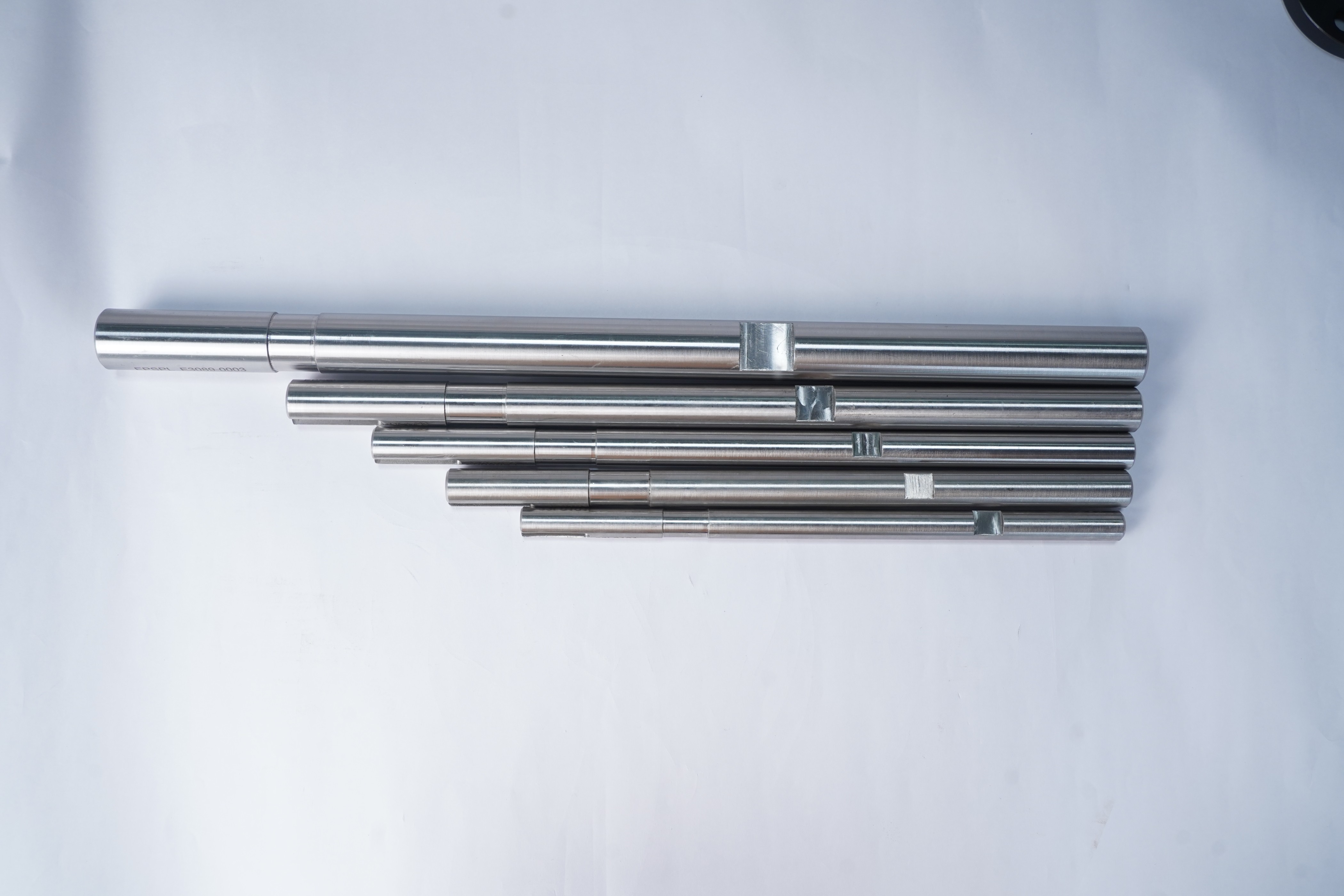 | Industrial Valve Shaft If you're looking for the highest quality shafts in india and Germany , Efficient Precision is your place. |
Frequently asked questions
How should manufacturers choose a valve shaft material?
Start with the load case, sealing zone and service medium, then compare stainless steel, carbon steel, alloy steel and copper-based options against strength, corrosion and wear requirements.
When are martensitic, duplex and nickel-alloy valve shafts worth the cost?
Martensitic grades suit applications needing hardness and wear resistance. Duplex grades justify their cost in chloride-bearing environments, while nickel alloys suit highly corrosive or high-temperature service.
What manufacturing controls matter for valve shafts?
Specify heat treatment, coating, straightness, runout, diameter tolerance and surface finish for each functional zone, especially where the shaft passes through packing or a bellows seal.
Which valve shaft design should manufacturers use?
Choose one-piece shafts for structural continuity, split shafts for assembly or maintenance, keyed shafts for simple torque transfer and splined shafts for compact, repeatable actuator connections.