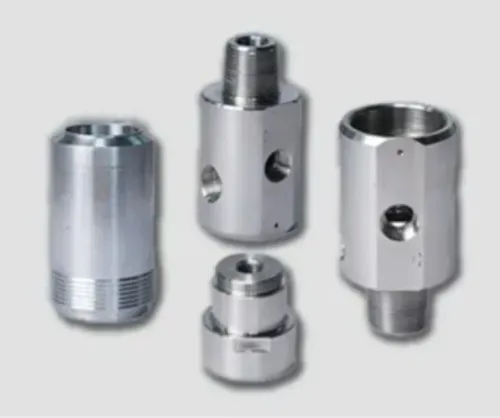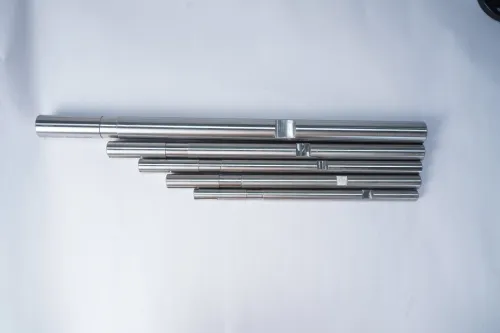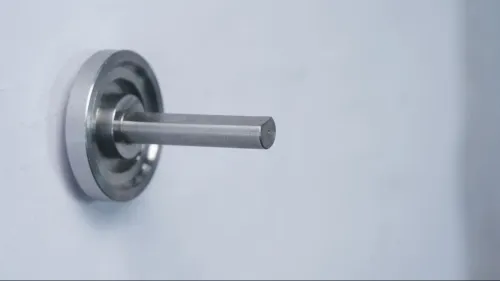

Smaller doesn't necessarily mean simpler.
In fact, small turned components can become technically demanding because there is less material available to absorb cutting forces, features may be tightly packed together and dimensional tolerances can represent a significant percentage of the component's overall size.
Think about a miniature pin containing several diameters, a fine thread and a small groove. Every feature must be positioned correctly, yet the entire component may be only a few millimetres in diameter.
This is one reason sliding head and Swiss-type CNC technologies are commonly considered for miniature precision work. Supporting the material near the cutting zone can improve stability while small features are being generated.
Multi-axis machining can add another advantage. Depending on component design and machine configuration, turning, drilling, cross drilling, milling and threading operations may be integrated into the production cycle. Fewer independent setups can simplify handling and reduce opportunities for alignment variation.
Still, the machine cannot compensate for an impractical drawing.
Very deep narrow grooves, extremely thin walls or unnecessary tolerances can make production more difficult and expensive. Early communication between designers and manufacturing teams can therefore be valuable, especially for newly developed components.
Pune's engineering ecosystem includes businesses working across automotive systems, industrial equipment, instrumentation and other precision-dependent sectors. Efficient
Precision & System Pvt.Ltd supports component requirements within this manufacturing environment.
Before finalising a new small turned part, it can be useful to review whether the design is practical for repeat production.
Send your drawing and material details to discuss machining possibilities before moving into a larger production quantity.