
The right choice depends on the port, fluid, debris type and service duty—not simply on whether the assembly contains oil or coolant. By the end, you can identify suitable automotive applications, complete a fit and performance check, and decide when a different filtration or plugging method is more cost-effective.
Key takeaways
- Use magnetic plugs at serviceable oil openings, not pressure-critical lines.
- Match magnet material and strength to debris, fluid and operating temperature.
- Specify thread, seal, pressure rating and inspection access before ordering.
- Require material certificates, dimensional inspection and traceability from suppliers.
Where magnetic pipe plugs make sense in an automotive plant
A magnetic plug belongs at a serviceable opening where oil collects wear debris and a technician can remove the plug for inspection. It is not a substitute for a pressure-rated isolation fitting, so do not place one as the primary barrier in a fuel rail, brake line, pressurised coolant hose or high-pressure hydraulic line.
| Location | Fit | Why it makes sense |
|---|---|---|
| Engine-oil sump drain | Strong | Captures ferrous wear particles and gives a technician a visible inspection point during oil changes. |
| Gearbox, axle or differential housing | Strong | These oil-filled cavities generate gear and bearing debris that a magnet can retain between service intervals. |
| Hydraulic powertrain unit drain or reservoir | Conditional | Use it at a low-pressure service port when the fluid contains recoverable steel debris and filtration remains in place. |
| Coolant circuit drain or inspection port | Limited | Choose it only where testing shows ferrous contamination; aluminium, copper and nonmagnetic stainless particles will pass it. |
| Production-line oil reservoir, test rig or flushing system | Conditional | It can indicate assembly debris in a low-to-moderate-volume tank that operators inspect manually. |
| Pressurised fuel, brake or coolant line | Poor | A magnetic plug does not create the pressure, leak or safety rating required for primary line isolation. |
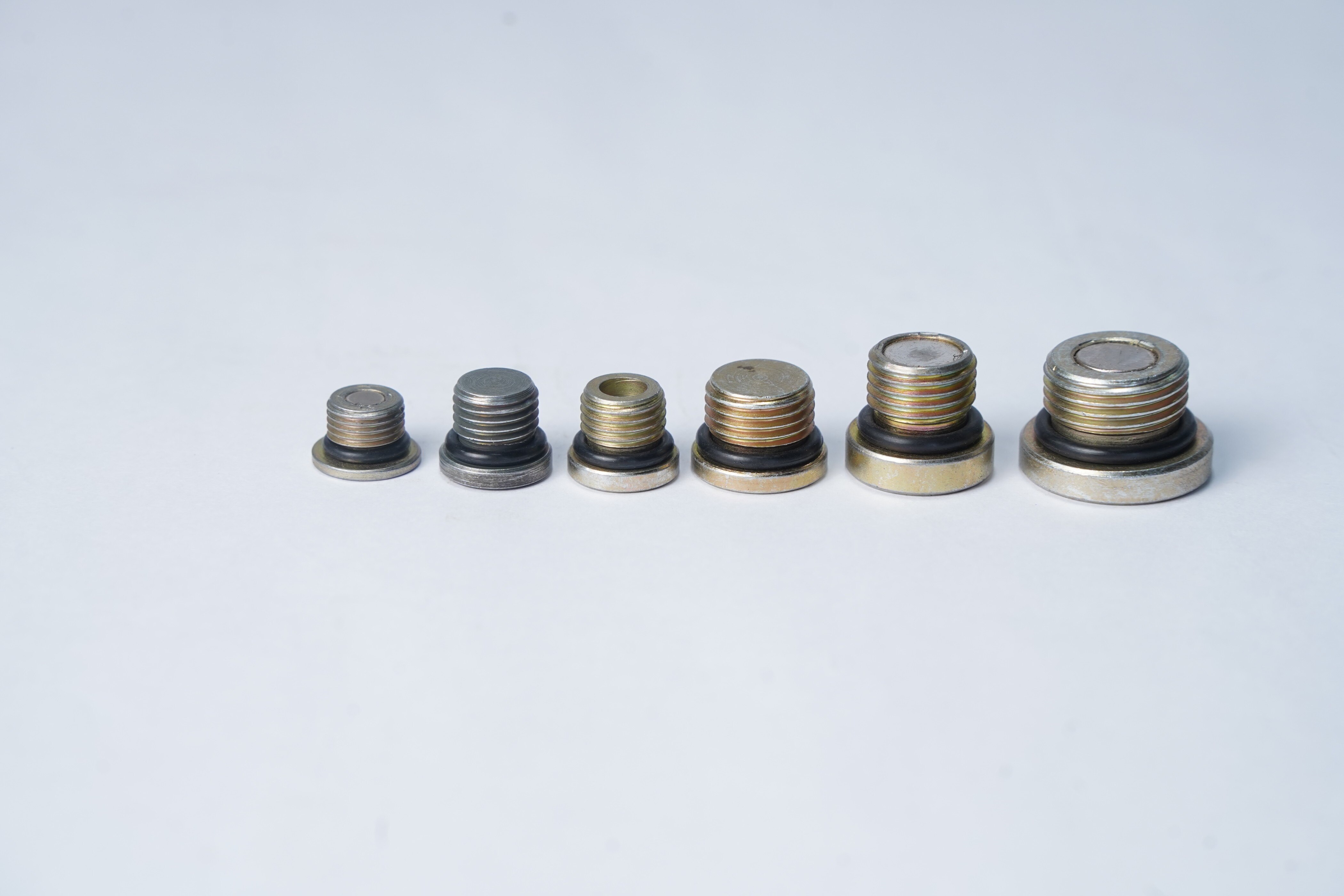
For magnetic pipe plugs for automotive manufacturers in Pune, the practical choice is an oil-filled assembly or low-pressure production fluid system with scheduled access. Automotive magnetic pipe plugs also need secure magnet retention and a coating compatible with the production oil, wash chemistry and temperature cycles; loose plating, adhesive or magnet fragments can become contamination.
Match the magnet to the debris, fluid and service conditions
Do not decide from magnet strength alone. Sample the target fluid at the planned drain interval and measure how much recoverable ferrous debris it contains. There is no universal gram-per-litre threshold; the business case is strongest when debris recurs, the assembly is costly to damage, and inspection results will change maintenance decisions.
Use a clean, nonmagnetic container and record the fluid volume, operating hours and component condition. Then:
- Pass a known volume across a test magnet with the proposed gap, seal and housing geometry.
- Rinse or wipe the captured material into a labelled sample container; do not judge only by what remains stuck to the magnet.
- Weigh dried ferrous material, photograph its colour and shape, and compare repeated samples.
- Investigate a sudden increase, bright flakes, needles, heavy paste or coarse chips rather than treating every dark sludge deposit as normal wear.
Iron and most steel respond well. Aluminium, copper, brass, ceramic particles, abrasive dust and many stainless-steel grades will pass through, so a low magnetic yield does not prove the fluid is clean.
A magnetic pipe plug earns its place when the captured mass is repeatable and its trend provides useful warning. It is weaker for continuous contamination control or fluids dominated by non-ferrous debris.
These magnetic pipe plug applications also require inspection at every drain interval; the magnet can concentrate debris while hiding its original quantity and morphology. Keep oil analysis and root-cause investigation after a failure.
Specify the plug so it fits and survives the port
Confirm the port drawing before choosing a magnet. A specification for pipe plugs for automotive suppliers must state the port’s nominal size, thread form, pitch, major diameter, depth and required effective thread engagement.
- Identify the thread standard: metric, NPT, BSP, or ISO 7-1. State whether it is tapered or parallel; apparent engagement between mismatched threads can damage the port and still leak.
- Define the seal: thread sealant for ISO 7-1, or the exact O-ring, bonded washer or gasket for a parallel thread. Give groove dimensions, seal material and replacement method.
- Record the plug’s overall length, head or drive size, insertion depth, clearance and removal method. A plug that bottoms in the bore can block a passage or crack a housing.
- Specify allowable working and proof pressure, minimum and maximum temperature, production oil or fluid, water exposure, salt spray and alkaline cleaning chemistry. Do not substitute an IP rating for immersion and pressure data.
- Name the magnet grade, operating-temperature limit, minimum pull or debris-capture requirement, coating and orientation. Require retention testing so a failed adhesive or encapsulation cannot release the magnet into the assembly.
Require coating compatibility with the actual fluid and cleaning cycle; nickel, epoxy, stainless sleeves and adhesive bonds fail differently under heat and thermal cycling. Order against a controlled drawing, then request thread-gauge results, material and coating certificates, leak-test records, batch traceability and written change notification. Local stock in Pune does not prove suitability.
Compare a magnetic plug with filters and standard plugs
A magnetic plug is the better choice when you need a compact, serviceable indicator of ferrous wear debris in a low- or moderate-volume oil cavity. It is worse than other options when contamination control must be continuous, non-ferrous particles matter, or the port requires certified high-pressure isolation.
| Option | Better choice when | Worse choice when |
|---|---|---|
| Magnetic plug | You can inspect it during draining or servicing and need to capture iron or steel wear particles | Aluminium, copper, brass, stainless-steel or abrasive particles dominate, or maintenance access is limited |
| Standard threaded plug | You need simple sealing, pressure-rated isolation, or a low-cost drain point with no debris indication | You need evidence of ferrous wear before a component fails |
| Strainer | You need coarse, continuous removal of mixed debris from a flowing circuit | Fine particles must be removed, pressure drop is tightly limited, or the debris settles in an oil sump |
| Inline magnetic filter | The circuit needs continuous ferrous-particle capture while operating | The system has no flow path, or manual inspection at a service opening is sufficient |
| Full filtration system | You need controlled cleanliness across flow, particle size and non-ferrous contamination | A small oil cavity only needs a serviceable ferrous-debris indicator |
Automotive magnetic pipe plugs complement filtration, flushing and cleanliness controls; they do not replace them. Validate the plug within the component cleanliness process under ISO 16232, and confirm that its pressure, temperature and sealing ratings match the port rather than assuming “magnetic” means pressure-safe.
What Pune buyers should require from a production supplier
A locally available industrial magnetic plug in Pune is not qualified by availability alone. Require a controlled drawing that states thread standard and size, effective engagement, seal design, pressure and temperature limits, magnet grade, pull or capture requirement, coating compatibility, and removal method. “Magnetic” by itself is not a performance specification.
Ask the supplier for this evidence:
- Material and coating certificates for the plug, magnet, sleeve and adhesive
- Thread-gauge results identifying metric, BSP or NPT form and size
- Batch traceability from raw material to inspection report
- Leak-test records at the specified pressure and duration
- Magnet-retention results after vibration, thermal cycling and fluid exposure
- Fluid-soak and cleaning-chemistry tests using your production oil, coolant or wash process
- A written change-notification process covering materials, coating, magnet, tooling and subcontractors
- Cleanliness results linked to your process, with ISO 16232 extraction and particle-measurement methods where required
| Supplier evidence | What it proves | Reject it when |
|---|---|---|
| Controlled drawing and gauge report | The plug matches the actual port | Thread convention or engagement is unspecified |
| Leak and retention records | The assembly remains sealed and the magnet stays secure | Tests use no defined pressure, temperature or duration |
| Batch and change records | You can contain a field or line issue | Parts cannot be traced to a lot |
Efficient Precision & System Pvt.Ltd can be considered only after it supplies this evidence for the exact configuration, not merely a catalogue sample. That discipline separates suitable magnetic pipe plugs for automotive manufacturers in Pune from parts that are simply made nearby.
Related product
 | Sliding head parts A Magnetic Pipe Plug is a specially constructed plug that seals pipe holes while also attracting and trapping ferrous (iron-based) particles in... View product → |
Frequently asked questions
Where do magnetic pipe plugs make sense in an automotive plant?
Use them at serviceable openings where oil collects ferrous wear debris and technicians can remove the plug for inspection. Do not use them as the primary barrier in fuel rails, brake lines, pressurised coolant hoses or high-pressure hydraulic lines.
How do you match a magnet to debris, fluid and service conditions?
Identify whether the debris is ferrous, check the oil or coolant chemistry, and confirm the magnet, seal and plug materials tolerate the operating temperature. Magnet strength must suit the particle size and inspection objective.
What should you specify for an automotive magnetic pipe plug?
Specify the port thread or geometry, plug dimensions, sealing method, pressure and temperature limits, magnet material and retention method, surface finish, and inspection access.
How do magnetic plugs compare with filters and standard plugs?
A magnetic plug collects ferrous debris at a service point and supports visual inspection. A filter provides continuous particle removal across a fluid circuit, while a standard plug closes an opening without collecting debris.
What should Pune buyers require from a production supplier?
Request dimensional inspection records, material and coating details, magnet retention evidence, pressure and leak-test results where applicable, lot traceability, and samples approved against the drawing.